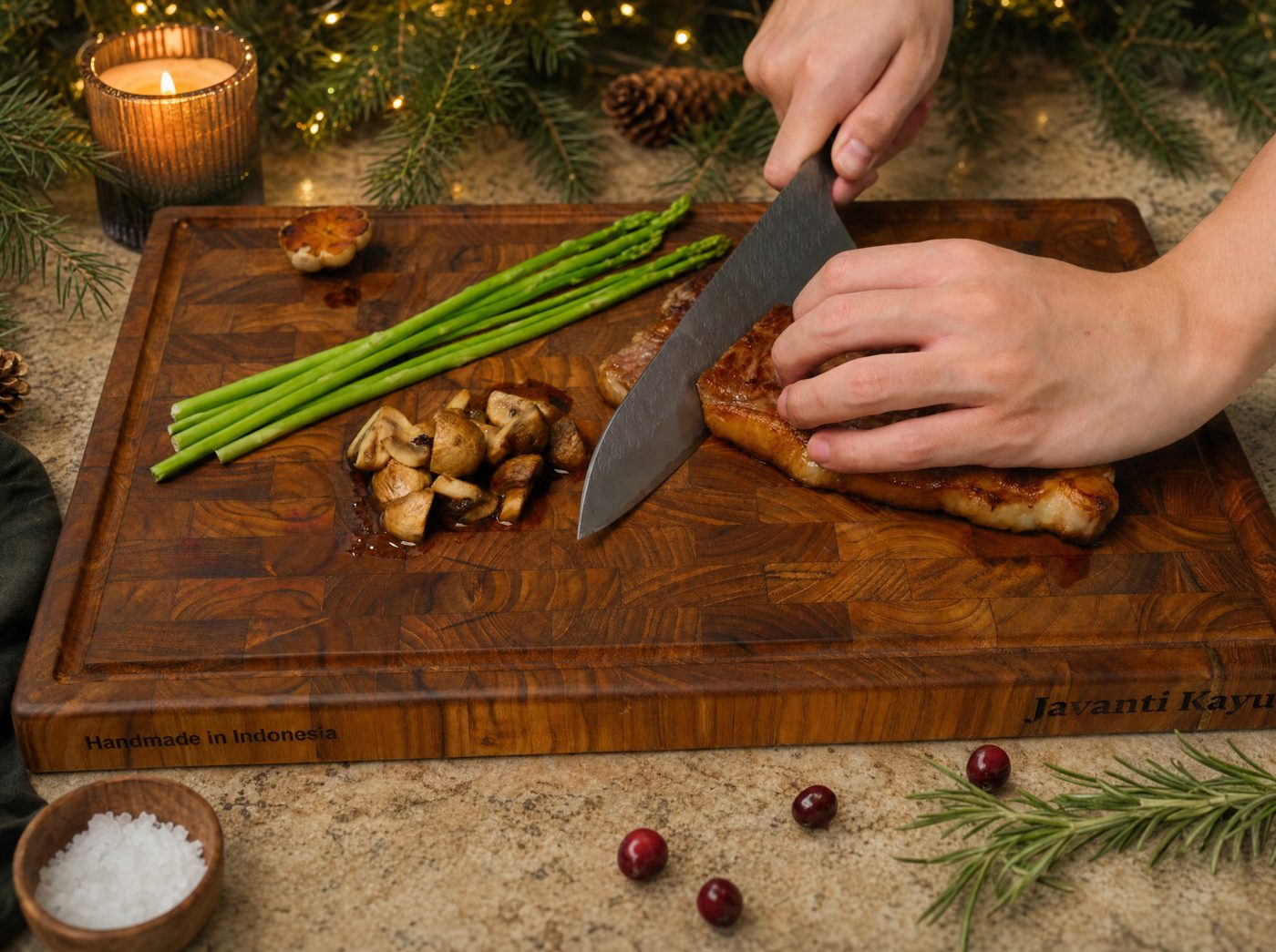
- Yes, teak makes a very good cutting board. It's naturally oily, so it handles water well and stays stable instead of warping.
- It's not especially hard. Teak scores 1,070 on the Janka hardness scale, softer than hard maple (1,450) and close to walnut (1,010).
- The honest catch: teak contains natural silica, which is mildly abrasive. It's probably a little harder on knife edges than maple or walnut.
- Construction matters more than the silica. On end grain your knife slips between the fibers instead of dragging across them.
- Good habits do the rest: slice instead of slamming, scrape with the spine, and hone often. That goes double for Japanese knives.
Ask around about teak cutting boards and you'll get two answers. One camp says it's the best board wood there is. The other, usually the people with expensive knives, says teak is full of silica and will dull your edge. Both have a point. Here's the whole picture, including the part a teak board brand might be tempted to skip.
Why teak ends up on so many good boards
Teak's reputation was built outdoors, on ship decks and garden furniture. It carries its own natural oils, and that does two useful things in a kitchen. Water beads up and sits on the surface instead of soaking straight in, and the wood moves less when it gets wet and dries again. Less movement means less warping and cracking, which is how most wooden boards actually die.
In practice, a teak board forgives you. Skip an oiling and it won't turn gray and thirsty as fast as maple would. It still needs some care (our teak cutting board care guide has the full routine, and this one covers which oils to use), just less of it. If you want teak side by side with walnut and acacia on looks and upkeep, we've got a quick comparison of the three. This article is about the question that one skips: what teak does to your knives.
Hardness: softer than you'd think
The Janka test measures how hard you have to push a small steel ball into wood before it sinks halfway. It's the standard way woodworkers compare hardness, and teak lands somewhere many people don't expect.
So teak is a fair bit softer than maple, the classic butcher block wood, and only a touch harder than walnut. That's good news for your knife. A surface with a little give lets the edge stop without slamming into something rigid.
The silica question (the honest bit)
Here's the part the forums argue about. Teak takes up tiny particles of silica, basically the mineral that sand is made of, from the soil it grows in. The Wood Database puts it at up to 1.4% of the wood and says it has a "pronounced blunting effect on cutting edges." That's not a myth. Woodworkers know teak eats saw blades and planer knives faster than most woods.
But a saw and a kitchen knife have very different jobs. A saw blade grinds through the wood itself, mile after mile of it. Your kitchen knife cuts through an onion and just touches the board at the bottom of each stroke. The silica is still there and it's still abrasive, so we'd expect teak to be a little harder on an edge than maple or walnut. How much harder, nobody really knows. We haven't found a proper controlled test of board woods and edge wear, and plenty of what's online (ours included, to be fair) is experience and reasoning rather than lab data.
"Teak is probably a little harder on edges than maple. Glass, stone and a careless chopping habit are a lot harder."
What we can say with confidence is where it ranks against the surfaces that really wreck knives. A glass, marble or slate board is in another league entirely. Bamboo is a common teak alternative, and it carries silica too, plus a lot of glue holding its strips together.
End grain changes the answer
This is the bit that matters most, and it's about how the board is built rather than which tree it came from. On a flat plank (face grain) or a striped board (edge grain), the wood fibers lie on their side. Every stroke, your edge runs across them, silica and all.
On an end-grain board, the fibers stand straight up like the bristles on a brush. The edge slips down between them and they part around it, then close back up. Less of the edge drags across the hard stuff, and the board shows fewer scars too. It's why butchers have used end-grain blocks for generations. (Our older piece on end grain vs edge grain vs face grain goes into how each one is built.)

That's why The Block is end grain and not a flat teak plank. If you're going to cut on teak every day, end grain is the construction that takes the sting out of the silica.
| Surface | How it treats your edge |
|---|---|
| End-grain teak | Gentle. Fibers part around the edge, a little silica in the mix |
| End-grain maple or walnut | Gentle, without the silica |
| Face or edge grain teak | Fine, but the edge runs across the fibers and silica on every stroke |
| Plastic | Easy on edges, but it scars and grooves quickly |
| Bamboo | Harder than it looks: silica plus lots of glue lines |
| Glass, marble, slate | The worst. Save them for serving |
What about Japanese knives?
This is where people get most nervous, and fair enough. A lot of Japanese knives use harder steel than the typical Western chef's knife, often around 60 or more on the Rockwell scale, and they're ground thinner. That edge is sharper and stays sharp longer, but it's less forgiving. Instead of bending over, a very hard, thin edge tends to chip when it hits something it doesn't like.
The honest advice: an end-grain teak board is fine for Japanese knives if you use them the way they're meant to be used. Slice with a smooth push or pull, don't rock hard or chop straight down into the board, and never twist the blade in a cut. If you own a very hard, very thin knife and you want to baby it, a softer board is the traditional choice in Japan (hinoki, a Japanese cypress, is the classic). Plenty of cooks keep one soft board for the precious knife and a big end-grain board for the rest.
Habits that keep any edge sharp longer
Here's the thing: how you cut matters more than what you cut on. A careful cook on teak will keep a sharper knife than a careless one on maple.
Stop scraping chopped food across the board with the sharp edge. Flip the knife and use the spine. It's the single biggest edge killer in most kitchens, and it's free to fix.
- Slice, don't slam. Let the knife travel forward or back as it cuts. Hammering straight down puts all the force on one tiny bit of edge.
- Hone often. A few light strokes on a honing rod before you cook straightens the edge back up. For hard Japanese steel, use a fine ceramic rod or a leather strop and go gently.
- Cut in the middle. Keep the blade off the juice groove and the board's edges, where it can catch.
- Wash the knife by hand. The dishwasher rattles edges against everything else in the rack.
So, is teak good for cutting boards?
Yes, with one honest footnote. Teak gives you a board that handles water, stays flat and looks better every year, and it's softer than maple, which your knife likes. The silica is real, and a flat teak plank is a less ideal daily cutting surface for that reason. Built end grain, teak keeps nearly all of its upside, and good cutting habits will matter more for your edge than the wood.

If that sounds like your kind of board, The Block comes in Large (17.7 x 11.8 x 1.2 in) for everyday prep and X-Large (23.6 x 15.7 x 1.6 in) for roasts and big batches. Not sure which? Our cutting board size guide sorts it out in a couple of minutes. And if steak knives are your worry, The Carve Plates are end grain too, so cutting your steak at the table goes down into the fibers instead of across a hard ceramic plate.
Keep it upright between uses (The Solo Stand holds both sizes), oil it when it looks pale, and hone your knife now and then. Your board and your knives will get along just fine.