- Rest it first. At least an hour, wrapped, and longer is better as long as it stays above 140°F.
- A brisket is two muscles, the flat and the point, and their grain runs in different directions. Separate them before you slice.
- Slice the flat across the grain, about the thickness of a pencil. Cut the point a little thicker, or cube it.
- Use a long slicing knife and long, smooth strokes. Don't saw.
- Only slice what you're serving right now. Keep the rest whole and wrapped so it doesn't dry out.
You spent twelve hours on it, maybe more. You babysat the stall and wrapped it at the right moment. And then the last five minutes, the slicing, decide whether all that work turns into tender, juicy slices or a pile of stringy, chewy meat.
The good news: slicing brisket isn't hard once you know what you're looking at. It comes down to reading the grain, and the grain is a little sneaky on a brisket. Here's how to do it right, plus the setup that keeps your counter from turning into a grease slick.
First, let it rest (longer than you think)
A brisket comes off the smoker with its juices still moving around and its fibers tight. Cut it straight away and you'll watch a puddle run across the board. Let it rest and the meat relaxes and holds onto that moisture.
Most pitmasters rest a whole brisket for at least an hour, and plenty go two or more. Keep it wrapped in its butcher paper or foil, wrap that in an old towel, and set it in an empty cooler. A big brisket holds its heat for hours that way. The one rule: keep it above 140°F, which is the USDA's line for keeping hot food hot. A probe thermometer left in the thick end makes that easy to watch.
It's the same idea we covered in how to rest a steak, just stretched out to suit a much bigger cut.
Know your brisket: the flat and the point
A whole "packer" brisket is really two muscles stacked on top of each other, joined by a thick seam of fat. That's the whole reason brisket gets sliced wrong so often.
| The flat | The point | |
|---|---|---|
| Where | The long, thinner, even end | The thick, rounded hump on top at one end |
| Fat | Leaner | Well marbled, rich |
| Grain | Runs the length of the brisket | Runs at a steep angle to the flat, close to a right angle |
| How to cut it | Across the grain, about ¼ inch | Across its own grain, about ⅜ inch, or cubed for burnt ends |
If you slice the whole thing in one direction, you'll be cutting across the grain on one muscle and right along it on the other. Half your slices will come out chewy. The fix is simple: treat them as two separate cuts.
The grain is easy to see on a raw brisket and hard to see under a dark bark. Before it goes on the smoker, trim a small corner off the flat, cutting across the grain. After the cook, that notch tells you exactly which way to slice.
Set up the board
A whole cooked brisket is big, heavy and seriously juicy, and a good part of what comes out of it is rendered fat. Your board has three jobs: give you room, stay put, and keep all of that off the counter.
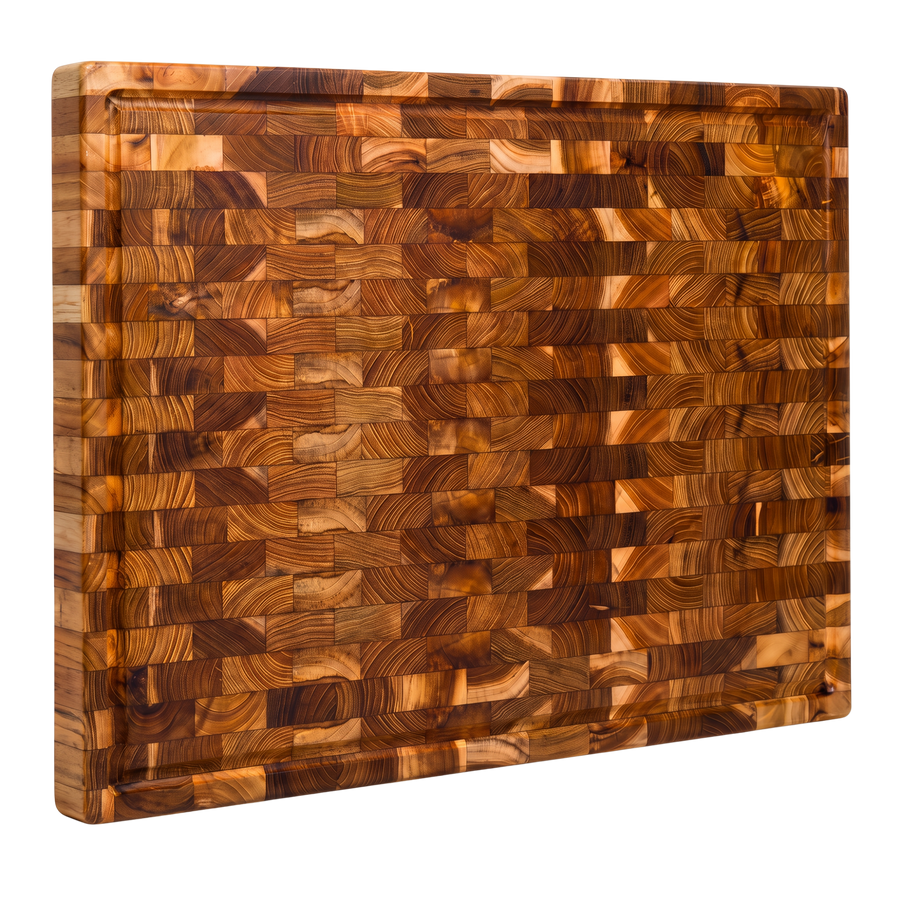
- Room. You need space for the brisket, the growing row of slices and your free hand. A whole packer, even after it shrinks on the smoker, often runs longer than an everyday board. Our The Block in X-Large is 23.6 by 15.7 inches, which leaves room to separate the point and work on both halves without shuffling things around. Not sure what fits your counter? The cutting board size guide walks through it.
- Weight. Lay a damp kitchen towel under the board so it can't slide. A thick end-grain board helps too: the X-Large is 1.6 inches of solid teak and barely notices a long knife stroke.
- A juice groove. This is the one that matters most with brisket. A carved channel around the edge catches the juice and fat as you slice, instead of letting it run off the side.

For the knife, a long slicing knife is the tool for the job. Something around 12 inches with a rounded tip lets you go through the flat in one or two long strokes, which keeps the bark on and the slices clean. A granton edge (the little scallops along the blade) helps the slices fall away instead of sticking. No slicer? A long serrated bread knife does a decent job on a crusty bark. Whatever you use, make it sharp. A dull blade crushes the meat and squeezes out the juice you just spent two hours keeping in.
How to slice brisket, step by step
1. Unwrap it on the board
Open the paper or foil right on the board, not over the sink. There'll be juice in the wrap, and you want to keep it. Pour it into a bowl and set it aside.
2. Separate the point from the flat
Find the fat seam between the two muscles. You'll see it on the side of the brisket where the point sits on top of the flat. Run your knife along that seam and the point lifts off with very little effort. Trim away the thickest of the leftover fat on both pieces.
3. Slice the flat across the grain
Turn the flat so the grain runs left to right in front of you, then cut straight down across it. Aim for slices about a quarter inch thick, roughly the width of a pencil. A well-cooked flat slice should hold together when you lift it, then pull apart with a gentle tug. If it falls apart under its own weight, it's a touch overdone. If it won't pull apart at all, it needed more time.
4. Slice the point on its own grain
Look at the point fresh. Its fibers run at a steep angle to where the flat's did, so turn it until they run left to right, then slice across. Point slices can go a little thicker, about ⅜ inch, because the extra fat keeps them tender. Or cut the point into 1 inch cubes, toss them in a little sauce and give them another hour in the smoker. That's burnt ends.
5. Only slice what you'll serve
Sliced brisket loses moisture fast. Cut enough for the first round and leave the rest whole, wrapped, in the cooler. Slice more when people come back for seconds.
Two muscles, two grains, two cuts. That's the whole trick.
Don't waste the juice
Between the wrap and the groove, you'll end up with a good amount of beefy, smoky juice. That's the best thing on the board. Spoon it back over the sliced flat before it goes to the table, which keeps the leaner meat moist while people help themselves. Or skim off some of the fat and stir it into your barbecue sauce.

If you like serving each plate with its own juice catch, the Carve Plates are individual end-grain teak plates with a deep groove around the meat and a separate zone for sides. Brisket, beans and slaw all stay where you put them. And when you're feeding a crowd, the big board can go straight to the table, the same way we serve the bird in how to carve a turkey.
Cleanup and leftovers
Leftovers first: get them into the fridge within two hours. Leftover brisket keeps best in larger pieces, so if you can, store it unsliced with a spoonful of the juice, then slice it cold and warm it gently.
Then the board. Brisket leaves more fat behind than most cuts, so give it a proper wash: scrape it, then scrub with hot water and a little dish soap, which cuts the grease. Never soak it and never put it in the dishwasher. Towel it off and stand it on its edge so both faces dry evenly. The Solo Stand takes boards up to 2.4 inches thick, so the X-Large fits. Once it's fully dry, if the wood looks pale or thirsty, give it a coat of oil. Our teak cutting board care guide has the full routine.
That's it. Rest it long, split the point from the flat, slice each one across its own grain, and only cut what you're serving. Twelve hours of smoke deserves a good five minutes at the board.